Paper vs Spigot vs Forge vs Fabric: Which to Choose
Paper, Spigot, Purpur, Folia, Forge, NeoForge and Fabric explained plainly: what each Minecraft server software does and which fits how you play.
If you want plugins and a smooth server, pick Paper. If you want mods that change the game, pick Fabric for lightweight and fast-updating setups, or NeoForge (the successor to Forge) for the big content mods and modpacks. Spigot still works, but Paper does everything it does and does it faster. The rest of this page explains why, so you can choose with your eyes open.
The two families: plugins and mods
Before comparing names, know that Minecraft server software falls into two families, and they do not mix cleanly.
- Plugin servers (Paper, Spigot, Purpur, Folia) add features only on the server. Players join with a normal, unmodified game. Think commands, economies, claims, minigames.
- Mod servers (Fabric, Forge, NeoForge, Quilt) change the game itself: new blocks, dimensions, machines. Players usually need the same mods installed on their computer.
The difference is covered in depth in Minecraft plugins vs mods. Decide that first; the software choice follows.
Quick comparison
| Software | Family | Best for | Watch out for |
|---|---|---|---|
| Vanilla | None | A pure, official experience | Almost no tuning and no plugins |
| Spigot | Plugins | Compatibility with older setups | Slower than Paper |
| Paper | Plugins | Most servers: survival, lobbies, minigames | Not for mods |
| Purpur | Plugins | Paper plus many extra gameplay options | Fewer people run it, so fewer guides |
| Folia | Plugins | Very large, spread-out worlds | Plugins must support it explicitly |
| Fabric | Mods | Light, fast mods and performance mods | Smaller catalog of huge content mods |
| Forge / NeoForge | Mods | Large content mods and classic modpacks | Heavier, slower to start |
| Hybrids (Mohist, Magma, Arclight) | Both | Mods and plugins together | Can be unstable; support varies |
Paper: the safe default
Paper started as a fork of Spigot and keeps compatibility with Spigot and Bukkit plugins, while fixing bugs and optimizing the game loop. It has a large community and a huge plugin ecosystem. If you are unsure what you need, start here. It is what most survival, SMP and minigame servers run.
Spigot: still around, rarely the best pick
Spigot is the long-standing plugin server and the base that Paper builds on. You may choose it for a plugin that demands it or a very old setup. For a new server, Paper gives you the same plugin compatibility with better performance.
Purpur and Folia: Paper, but more specialized
Purpur is a Paper fork that exposes many more gameplay settings (tweaks to mobs, mechanics and commands). It is a good fit if you want to adjust details without installing a plugin for each one.
Folia splits the world into regions that tick on separate threads. It can help very large servers with players spread over a big map, but most plugins are not written for it. Treat it as an advanced option, not a default.
Fabric: lightweight and quick to update
Fabric is a small, modular mod loader. It tends to support new Minecraft versions quickly, and it hosts many performance-oriented mods. Pick it for a "vanilla plus" server, for technical players, or when your favorite mods are Fabric-only.
Forge and NeoForge: the heavy-content route
Forge defined Minecraft modding for years, and many large modpacks were built on it. NeoForge is a community fork created after a split in the Forge project, and it is where much of the newer development happens. Check which loader your mods or modpack require before you decide: the mod list picks the loader, not the other way around.
Tip: a mod built for Forge will not load on Fabric, and the reverse. Always match the loader and the Minecraft version.
What about running both mods and plugins?
Hybrid servers such as Mohist, Magma and Arclight try to load both. They can be convenient, but you are combining two systems that were not designed together, and bugs are harder to track down. If you can get what you need from one family, do that.
Which one for which situation?
- Survival with friends, economy, land claims: Paper.
- A lobby or minigame network: Paper behind a Velocity proxy.
- A big modpack from CurseForge, FTB or Modrinth: the loader the pack asks for, usually NeoForge, Forge or Fabric.
- Vanilla plus (performance mods, shaders, small tweaks): Fabric.
- Pure vanilla, no changes: Vanilla.
Switching later
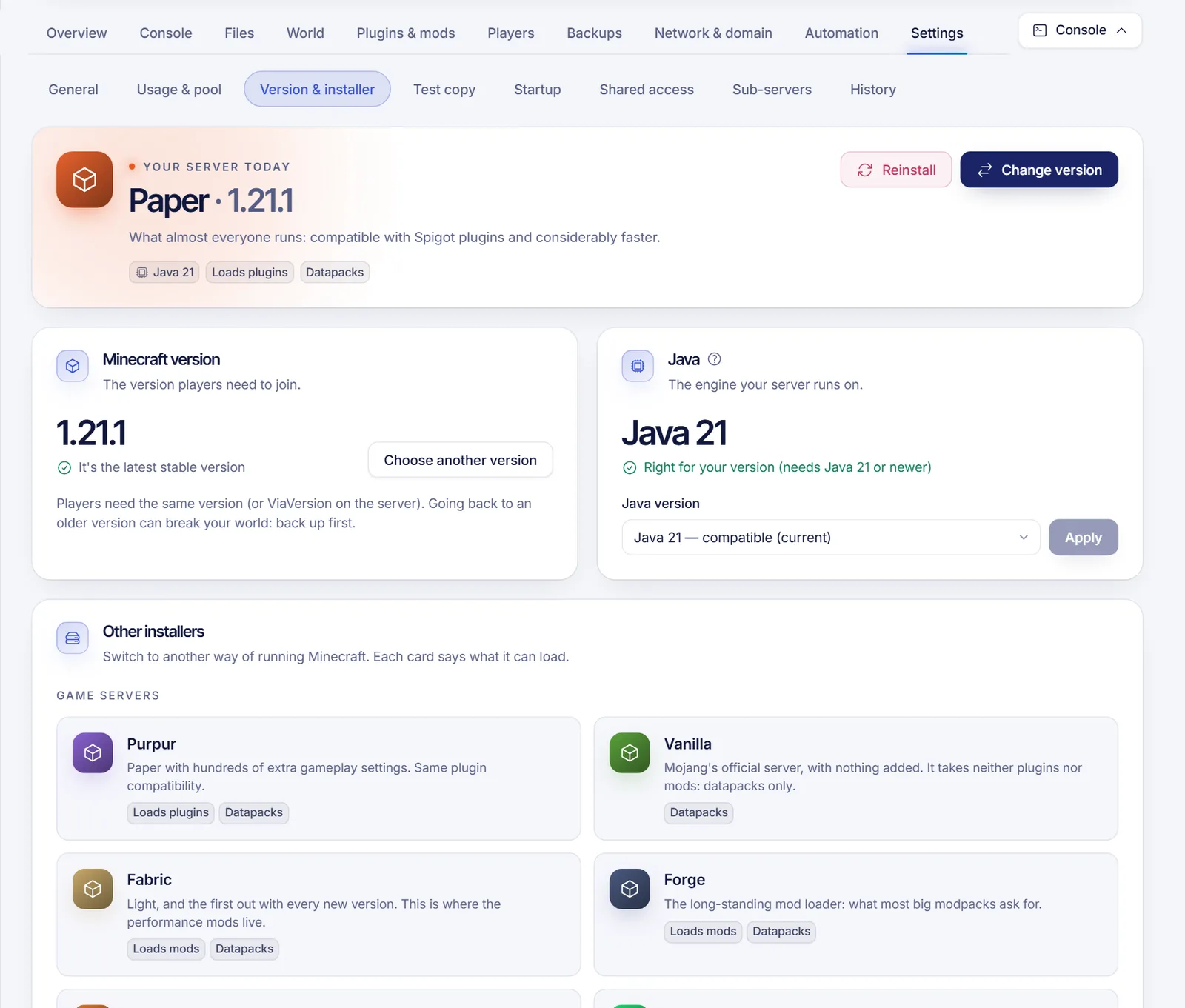
You are not locked in. On a managed panel such as SolumeCore's, the installer tab lets you change software yourself, and it warns you if the new one will not load the plugins or mods already installed. Still, back up first, because a world opened by a different loader can behave differently. See how to back up a game server.
FAQ
Is Paper better than Spigot?
For almost every new server, yes. Paper keeps Spigot plugin compatibility and adds performance work and fixes.
Should I use Forge or NeoForge?
Use whichever your mods or modpack are built for. For new projects on recent Minecraft versions, NeoForge is where most active development is.
Can I use plugins on Fabric or Forge?
Not directly. Plugins are written for Bukkit-based servers. Fabric and Forge use mods. A hybrid server can load both, with the trade-offs described above.
Which software uses the least RAM?
Paper and Fabric are efficient choices, and the real memory use depends on your player count, world and add-ons far more than on the brand. See how much RAM a Minecraft server needs.
Can I convert a Paper world to Forge?
Often the world itself carries over, but plugin data and mod content do not. Always test on a copy.
Choose and start
Ready to set one up? Follow how to make a Minecraft server or go straight to Minecraft hosting, where all of the software above is available from the installer tab.