Paying for Hosting With Crypto: An Honest Guide
How to pay for hosting with cryptocurrency step by step: which coins and networks to choose, how long confirmation takes and the real risks to know.
You can pay for hosting with cryptocurrency by choosing crypto at checkout, picking a coin, and sending the exact amount shown to the address on your invoice before the countdown ends. Once the network confirms the payment, the service is delivered automatically. It works well, but it has trade-offs that card payments do not: transfers are irreversible, you pay the network fee, and sending on the wrong network can lose your money for good. This guide covers the process and the risks without the hype.
Why people pay with crypto
- Payment options: some people do not have, or do not want to use, a card.
- Borderless: it works the same wherever you are.
- Less personal data on the payment itself: you do not hand over card details. (Your account and billing details still follow the host's normal requirements.)
- Stablecoins let you pay in a value pegged to a currency, avoiding most price swings.
It is not the right choice for everyone. If a card works for you, it is simpler, and it keeps your payment tied to consumer protections that crypto does not have.
How it works at SolumeCore checkout
- Add a plan to the cart and go to checkout.
- Choose Continue with crypto as the payment method.
- An invoice is created. Pick the coin you want to pay with from the list that the payment processor offers.
- You are shown an exact amount, a destination address (with a QR code) and a countdown. Some networks also need a memo or tag; if shown, you must include it.
- Send the payment from your wallet or exchange.
- The payment moves through the stages waiting, confirming, confirmed and finished. When the network confirms it, the service is delivered by itself; you do not need to open a ticket.
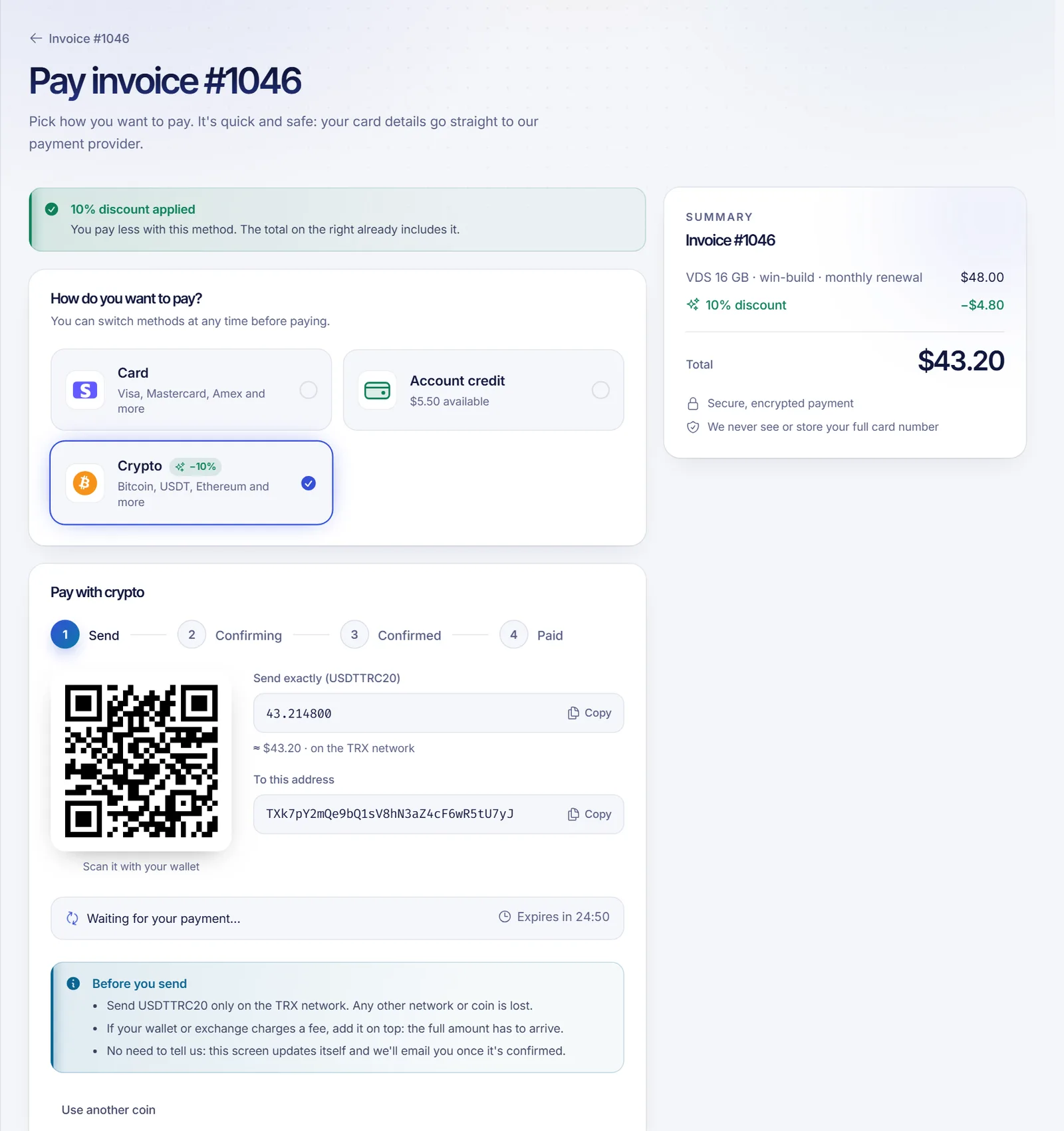
The list of coins comes from the payment processor and can change. Commonly offered options include Bitcoin, Ethereum, Litecoin, Solana and stablecoins such as USDT and USDC on various networks.
Choosing a coin and a network
This is the part where people lose money, so slow down.
| Choice | Pros | Watch out for |
|---|---|---|
| Bitcoin | Widely held | Slower confirmation, fees vary |
| Litecoin | Faster and cheaper than Bitcoin | Fewer wallets |
| Stablecoins (USDT, USDC) | Stable value | Several networks exist for the same token |
| Ethereum | Common | Network fees can be high |
For stablecoins, the network matters as much as the coin. USDT on one network and USDT on another are different routes. Whatever network is shown on the invoice is the one you must send on. If you choose another, your funds may not arrive and are usually not recoverable.
Warning: before sending, check that the coin, the network and the address match the invoice exactly. Copy and paste the address or scan the QR code, and send a small test only if the network and amount allow it.
Fees: who pays what
- Network fees are charged by the blockchain and go to the validators, not to the host. They are paid from your wallet on top of the invoice amount.
- Exchanges often charge a withdrawal fee. Sending from an exchange can therefore deliver less than you intended; make sure the amount received equals the invoice amount.
If you send less than the invoice requires, the payment may not complete. If that happens, do not send a random top-up: open your invoice and follow the instructions, or contact support with the transaction ID.
Timing: how long does it take?
- It depends on the network and its congestion, from under a minute to longer.
- Don't leave the countdown to the last minute. If it expires, create a new payment instead of sending to the old address.
- You can leave the page and come back; the invoice keeps its status.
Risks, honestly
- Irreversible. There is no chargeback. If you send to the wrong address or network, nobody can pull it back.
- Volatility. The amount is fixed for the time window of the invoice, but between buying crypto and paying it the price can move. Stablecoins reduce this.
- No refunds. SolumeCore does not refund crypto payments, and a transfer cannot be reversed. Check the amount, the coin and the network before you send; do not assume funds can return to your wallet.
- Scams. Never pay an address somebody sent you in a chat. Only use the invoice in your account.
- Taxes. In many places, paying with crypto can be a taxable event. Ask a professional if it applies to you.
Practical tips
- Use a wallet or exchange you already know and have used before.
- Double-check the amount received after fees.
- Keep the transaction ID until the service is active.
- For recurring services, remember that crypto invoices need a manual payment each time unless your plan says otherwise. Set a reminder.
FAQ
Can I pay a recurring hosting plan in crypto?
You can pay each invoice in crypto. Crypto does not auto-charge your wallet, so expect to send the payment for each renewal.
Is crypto payment anonymous?
Not fully. Blockchain transactions are public, and the host still needs account details for billing and abuse prevention.
What if my payment is stuck?
Check the transaction on a block explorer. If it is confirmed there but your invoice has not updated, contact support with the transaction ID.
Can I get a refund in crypto?
No. At SolumeCore all payments are final and non-refundable, and crypto transfers are irreversible. The details and the few exceptions are in section 11 of the terms of service.
Which coin is the cheapest to send?
Usually coins on faster, cheaper networks. Compare the network fee in your wallet before you confirm.
Ready to pay?
Pick a plan on the plans page, or go straight to Minecraft hosting, a VPS or web hosting. The help center has short answers on billing.